



ORGANS OF PARIS © 2026 Vincent Hildebrandt HOME ALL ORGANS




The choir organ was an instrument of Robert Boisseau in
the old buffet of Merklin.
Several instruments have followed one another in the choir
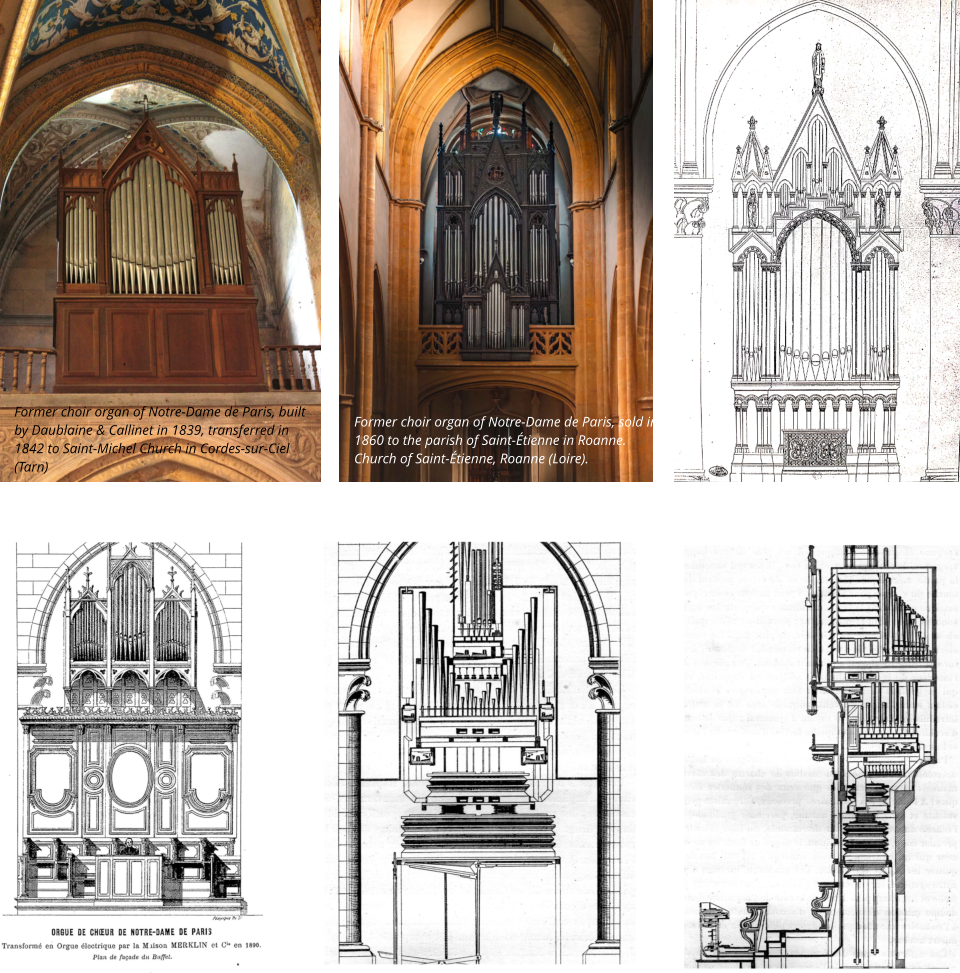
of the cathedral. A Daublaine-Callinet of ten stops in 1839
not powerful enough and sold in 1841 to St Michel at
Cordes-sur-Ciel not far from Albi where it remains today and
with the addition of a pedal stop.
Then a second organ of the same organ maker in 1841
installed on the right side. But its aesthetics and its
installation did not suit Viollet-le-Duc, it was thus sold to the
Saint-Etienne church in Roanne (Loire).
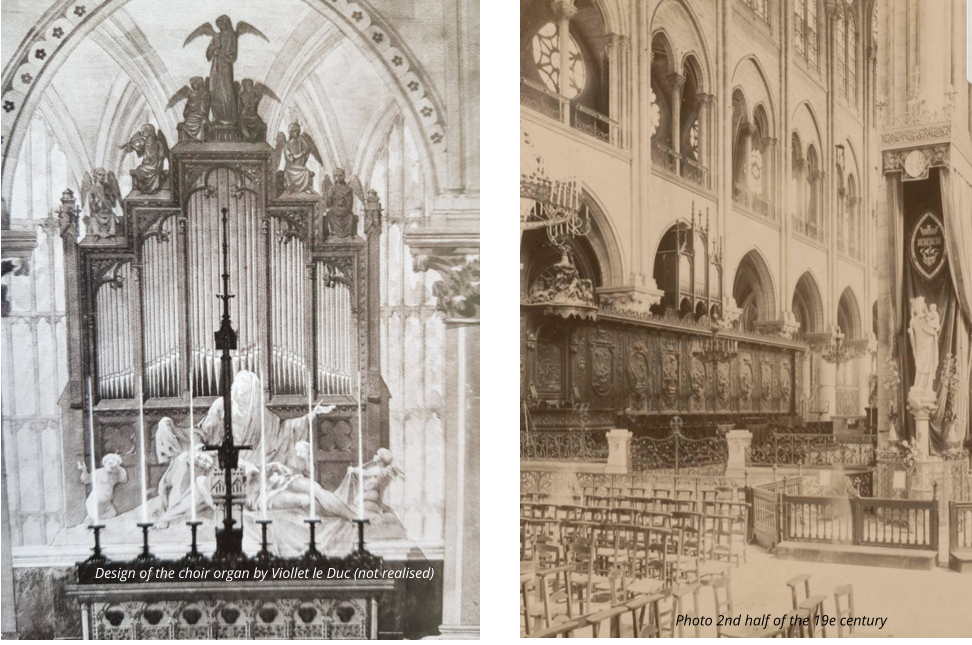
In 1869, they chose a 17-stop Merklin organ with a Gothic
case designed by Viollet-le-Duc, installed on the left side of
the choir.
A 1890 restoration by Joseph Merklin started converting the
action to electro-pneumatic and adding combinations, but
since the modernization wasn't reliable, Mutin (Cavaillé-
Coll's successor) was asked to fix it up.
Further work followed (Beuchet in 1938, Hermann in 1953),
but the organ never worked properly.
(Source: Facebook @Aristide Cavaillé-Coll)
1968
As part of the liturgical space updates and adapting to the
new rite, Robert Boisseau delivered a new 28-stop
instrument (later expanded by 2 stops) in a French neo-
classical style, inspired by Pierre Cochereau. A 16' flute was
added to the pedal in 1970, outside the case.
The pedal chalumeau was replaced by a clarion in 1989. In
2005, Philippe Guyonnet cleaned it and Bertrand Cattiaux
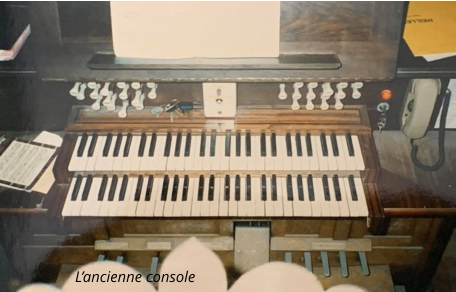
tuned it. In 2010, Bertrand Cattiaux did more work and
installed a new console.
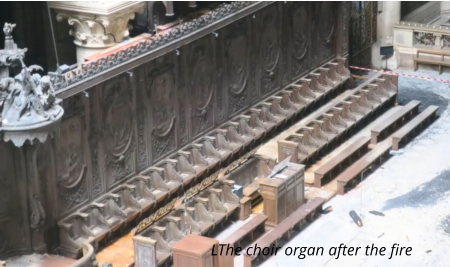
In 2019, the organ was badly damaged in the cathedral fire
on the evening of April 15. The flames spared it, and the
pipes didn't melt, but it got completely soaked. Just minutes
before the fire, it had been playing for vespers and evening
mass.
Only the case (designed by Viollet-le-Duc) will be restored and
kept. The instrumental part has to be fully rebuilt. The diocese
sees this as a chance "to significantly improve the instrument,
expand its repertoire, and project its sound better into the
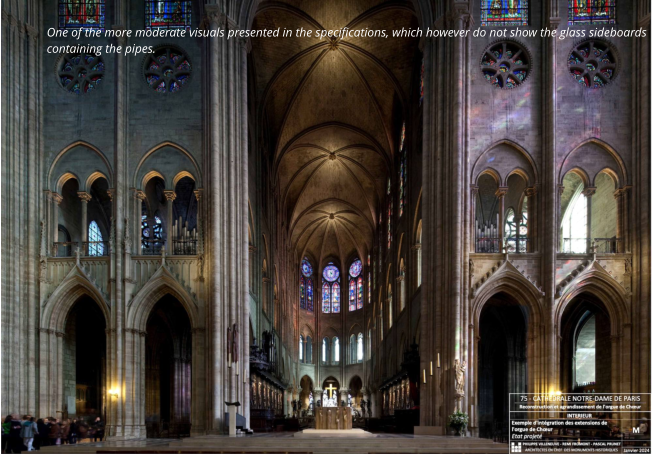
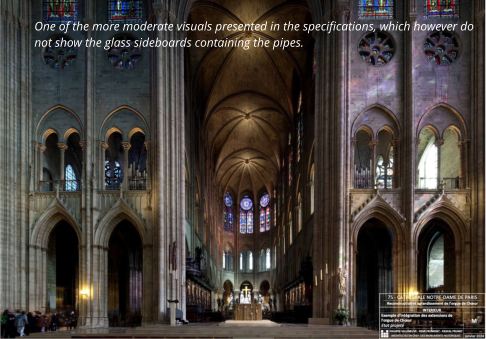
nave." To do that—and given the tight space in the
case—they've decided to add one or more extensions in the
choir gallery. The plan is to build it upward with vertical pipes
that will be visible (modest, simple, and discreet) and partly
hide the architectural view of the galleries.
Today, an electronic substitute (Allen) is in place.



Engravings of the choir organ of Merklin
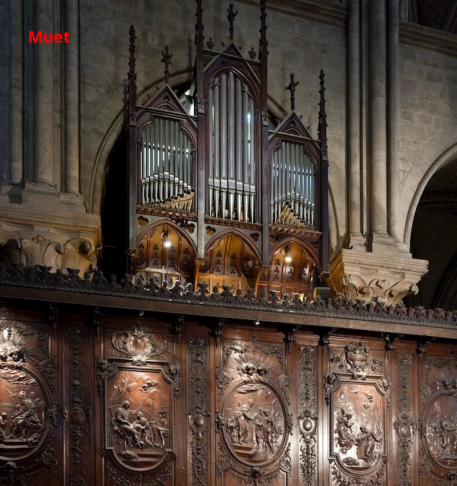
Buffet de Merklin (1869)
1968 - Boisseau
1970/1978/1989 - Jean-Loup Boisseau
2005 - Philippe Guyonnet & Bertrand Cattiaux
Composition 2019
Silent
Titular organist
Yves Castagnet
Titular organist adjoint :
Thibault Fajoles
Famous organists in the past:
Johan Vexo (-2024)
Léon Souberbielle (1920-1992),
Jacques Marichal (1934-1987),
Michel Chapuis (1930-2017).
Lire plus
Videos
Johan Vexo
The choir organ was destroyed in the fire,
mainly due to water damage. At present,
an electronic instrument is being used.
Funding for rebuilding the choir organ is
already in place, but discussions are still
ongoing about a possible enlargement. In
particular, the placement of the new stops
remains a sticking point.
The diocese sees this project as an
opportunity to significantly improve the
instrument, broaden its repertoire, and
project its sound more effectively into the
nave.
To achieve this—and given the limited
space in the case—they have decided to
add one or more extensions in the choir
gallery. The plan is to build upwards, with
vertical pipes that will remain visible
(modest, simple, and discreet), even if they
partially obscure the architectural view of
the galleries. However, this idea has
sparked considerable debate, which is still
ongoing.
The former choir organ
Silent








Organs of Paris


ORGANS OF PARIS © 2026 Vincent Hildebrandt
The choir organ was an instrument of Robert Boisseau in the
old buffet of Merklin.
Several instruments have followed one another in the choir
of the cathedral. A Daublaine-Callinet of ten stops in 1839 not
powerful enough and sold in 1841 to St Michel at Cordes-sur-
Ciel not far from Albi where it remains today and with the
addition of a pedal stop.
Then a second organ of the same organ maker in 1841
installed on the right side. But its aesthetics and its
installation did not suit Viollet-le-Duc, it was thus sold to the
Saint-Etienne church in Roanne (Loire).
In 1869, they chose a 17-stop Merklin organ with a Gothic
case designed by Viollet-le-Duc, installed on the left side of
the choir.
A 1890 restoration by Joseph Merklin started converting the
action to electro-pneumatic and adding combinations, but
since the modernization wasn't reliable, Mutin (Cavaillé-Coll's
successor) was asked to fix it up.
Further work followed (Beuchet in 1938, Hermann in 1953),
but the organ never worked properly.
(Source: Facebook @Aristide Cavaillé-Coll)
1968
As part of the liturgical space updates and adapting to the
new rite, Robert Boisseau delivered a new 28-stop instrument
(later expanded by 2 stops) in a French neo-classical style,
inspired by Pierre Cochereau. A 16' flute was added to the
pedal in 1970, outside the case.
The pedal chalumeau was replaced by a clarion in 1989. In
2005, Philippe Guyonnet cleaned it and Bertrand Cattiaux
tuned it. In 2010, Bertrand Cattiaux did more work and
installed a new console.
In 2019, the organ was badly damaged in the cathedral fire
on the evening of April 15. The flames spared it, and the
pipes didn't melt, but it got completely soaked. Just minutes
before the fire, it had been playing for vespers and evening
mass.
Only the case (designed by Viollet-le-Duc) will be restored and
kept. The instrumental part has to be fully rebuilt. The diocese
sees this as a chance "to significantly improve the instrument,
expand its repertoire, and project its sound better into the nave."
To do that—and given the tight space in the case—they've
decided to add one or more extensions in the choir gallery. The
plan is to build it upward with vertical pipes that will be visible
(modest, simple, and discreet) and partly hide the architectural
view of the galleries.
Today, an electronic substitute (Allen) is in place.

Buffet de Merklin (1869)
1968 - Boisseau
1970/1978/1989 - Jean-Loup Boisseau
2005 - Philippe Guyonnet & Bertrand Cattiaux
Composition 2019
Silent
Titular organist
Yves Castagnet
Titular organist adjoint :
Thibault Fajoles
Famous organists in the past:
Johan Vexo (-2024)
Léon Souberbielle (1920-1992),
Jacques Marichal (1934-1987),
Michel Chapuis (1930-2017).
Lire plus
Videos
Johan Vexo
The choir organ was destroyed in the fire, mainly due to water
damage. At present, an electronic instrument is being used. Funding
for rebuilding the choir organ is already in place, but discussions are
still ongoing about a possible enlargement. In particular, the
placement of the new stops remains a sticking point.
The diocese sees this project as an opportunity to significantly
improve the instrument, broaden its repertoire, and project its sound
more effectively into the nave.
To achieve this—and given the limited space in the case—they have
decided to add one or more extensions in the choir gallery. The plan
is to build upwards, with vertical pipes that will remain visible
(modest, simple, and discreet), even if they partially obscure the
architectural view of the galleries. However, this idea has sparked
considerable debate, which is still ongoing.
The former choir organ
Silent
